|
February 2019
In this edition of the News you will find:
 Building Unit Plans Building Unit Plans
Prepared Unit Plans
Get to Know a Cameo
... The Mushroom Hunt
... Mirror Patterns 1
Please feel free to distribute this information.
|
Email News Services
If you would like to subscribe please send an email request to: doug@blackdouglas.com.au:
- In the subject line write Subscribe Maths.
- In the body of message state which divisions you want to subscribe to, or simply write Subscribe All.
- Add your name and preferred email address.
Update messages are sent from:
Mathematics Centre monthly
Calculating Changes each term
Working with Mathematics Centre
will help you find your way around our site
Browsing Hint
Use the View/Zoom options of your browser to 'move' the page closer or further away. Ctrl +, Ctrl - and Ctrl 0.
|

- Building Units of Work
|
Since December five schools have joined the list which have invested in the eTask Package - 1 in each of Western Australia, South Australia, New South Wales, Victoria and Northern Territory. These schools will now be able to create their own problem solving Task Library and use the experience as a central focus of their professional development initiatives.
Down the track they will be wanting to create units of work that integrate tasks into the curriculum as a central core rather than an additional activity.
There are a number of ways Mathematics Centre can help and they are all driven by the Working Mathematically Process.
(See Link List below) |
- Content Finder
- When you know the specific content you want to tease out with your unit, go to the Task Cameo Content Finder (see Link List below).
- Look down the left column until you find it and any other related content. In the right column beside every content item is a list of tasks which involve that content.
- Each task is linked to its Task Cameo (our name for teaching notes). Research and choose.
- Go to the Unit Planning Models link below and select a structure for using the tasks in your classroom.
- Picture Puzzles
Every task is the tip of an iceberg. Sometimes that iceberg can be uncovered using an Investigation Guide which introduces questions beyond those on the card. Some Picture Puzzles menus are designed as Investigation Guides to extend particular tasks. Each menu has a Picture Puzzle for each of 5 tasks.
- When you know the broad content strand you want to explore with your unit, go to the Picture Puzzles Menus (see Link List below).
- Select the menu that suits you. Click the menu title to find its teaching notes. Research. Each Picture Puzzle slide show can be used to guide a whole class investigation and/or the menu can be an invitation for students to choose (with a partner) their own investigation. Perhaps for assessment of the unit.
- Go to the Unit Planning Models link below and select a structure for using the Picture Puzzles and their related tasks in your classroom.
Picture Puzzles are available either menu by menu ($66 each) or as the whole set, so consider purchasing unit by unit as you need them. Once you own a menu it is yours to use as you wish within your school.
- Menu Maths @ Café Conundrum
Café Conundrum presents four menus of investigations built around using Poly Plug - counters are an alternative. Each menu explores a different content strand.
- When you know the broad content strand you want to explore with your unit, go to the Menu Maths @ Café Conundrum link (see Link List below).
- Choose the menu that suits you. Click the menu title to find its teaching notes which include the information from the related Task Cameos. Research.
- Go to the Unit Planning Models link below and select a structure for using Menu Maths @ Café Conundrum. You will not need the related tasks.
Menu Maths @ Café Conundrum supplies the set of four menus as a PDF published for exclusive use as you wish in your school (or personal classroom). Each set is $11 and allows unlimited printing.
- Unit Planning Models
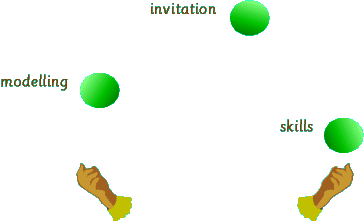
Generally a Working Mathematically unit will include:
- Time for students to select and explore their own investigation.
- Time to model for students what it means to work like a mathematician on an investigation.
- Time to practise skills connected with the unit.
The image above helps to keep this in mind during planning.
See Link List below for many models teachers have developed over several decades of working with tasks.
- Get to Know a Cameo
Task 38, The Mushroom Hunt
Six people go looking for mushrooms. Each one has a basket. When they return they compare the numbers of mushrooms in their baskets. They discover two things:
- Adding up the numbers gives a total of 63.
- Grouping the baskets in different ways gives sub-totals equal to every number from 1 to 63.
The problem is, of course, how many mushrooms are in each basket. It can be tackled at every level from an exploration of doubling, to an introduction of powers and indices, to the concept of binary numbers, to an investigation of multiplicative (exponential-like) growth.
|
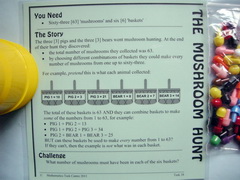 |
The cameo supports teachers to explore any or all of these content items and contains a journal entry from a Year 3 student whose recording process has them knocking on the door of discovering binary numbers.
In the eTask Package this task is in the 'easy to make' set because all you need is 6 small containers (paper or plastic cups for example) and 63 pretend mushrooms (mushroom pegs as used in the commercial game MasterMind are great), but anything else small and not too flat (such as 1cm cubes) can work.
Task 100, Mirror Patterns 1
This task testifies that mathematically thinking is not only about numbers and letters. It is about reasoning guided by self-directed questioning. As students place the mirror (or mirrors in the later challenges) on the dumbbell card they must be asking themselves some or all of:
- What happens if...?
- Can I try the mirror in every possible position?
- Have I seen a similar problem before?
These are mathematicians' questions.
|
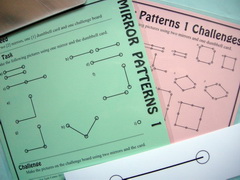 |
Using spatial tasks as the core (a list is suggested in the cameo) it is easy to create a Working Mathematically unit of work in this content strand. Some (perhaps many) students will demonstrate they 'can do mathematics' in a unit with this content as opposed to a unit in number or algebra.
Mirror Patterns 1 is in the 'extra work' group of tasks in the eTask Package because there are two cards in the task and a board of dumbbell shapes to print, laminate and trim. Nothing tricky; it just takes a little more time that some other ones.
Keep smiling,
Doug.
Link List
- Did you miss the Previous News?
If so you missed information about:
- Teachers at Work
- Making a Task Library
- Get to Know a Cameo
... McMahon's Triangles 1 & Sliding Tiles
- ...and more...
|
 |
Did You Know?
|

Previous News
November 2018 ... October 2018 ... September 2018
July 2018 ... June 2018 ... April 2018 ... March 2018 ... February 2018
December 2017 ... November 2017 ... October 2017 ... August 2017
July 2017 ... June 2017 ... May 2017 ... April 2017 ... February 2017
December 2016 ... November 2016 ... October 2016 ... September 2016 ... August 2016
July 2016 ... June 2016 ... May 2016 ... March 2016 ... February 2016
November 2015 ... October 2015 ... September 2015 ... August 2015
July 2015 ... June 2015 ... May 2015 ... April 2015 ... February 2015
Dec. 2014/Jan. 2014 ... November 2014 ... October 2014 ... September 2014 ... August 2014
July 2014 ... June 2014 ... May 2014 ... April 2014 ... March 2014 ... February 2014
Dec. 2013/Jan. 2014 ... November 2013 ... October 2013 ... September 2013 ... August 2013
July 2013 ... June 2013 ... May 2013 ... March 2013 ... February 2013
Dec. 2012 / Jan. 2013 ... November 2012 ... October 2012 ... September 2012 ... August 2012
June/July 2012 ... May 2012 ... April 2012 ... March 2012 ... February 2012 ... January 2012
December 2011 ... November 2011 ... October 2011 ... September 2011 ... August 2011
July 2011 ... June 2011 ... May 2011 ... April 2011 ... March 2011 ... February 2011
Dec 2010/Jan 2011 ... November 2010 ... October 2010 ... September 2010 ... August 2010
July 2010 ... June 2010 ... May 2010 ... April 2010 ... March 2010 ... February 2010
Dec.2009/Jan.2010 ...November 2009 ... October 2009 ... September 2009 ... August 2009
July 2009 ... June 2009 ... May 2009 ... April 2009 ... March 2009 ... February 2009
Dec.2008/Jan.2009 ... November 2008 ... October 2008 ... September 2008 ... August 2008
July 2008 ... May/June 2008 ... April 2008 ... March 2008 ... February 2008
Dec.2007/ Jan.2008 ... November 2007 ... October 2007 ... August/September 2007
... July 2007 ... June 2007 ... May 2007 ... April 2007 ... March 2007 ... February 2007
Dec. 2006/ Jan. 2007 ... November 2006 ... October 2006 ... September 2006 ... August 2006
July 2006 ... June 2006 ... May 2006 ... April 2006 ... March 2006 ... February 2006
Dec. 2005/ Jan. 2006 ... November 2005 ... October 2005 ... September 2005 ... August 2005
July 2005 ... June 2005 ... May 2005 ... April 2005 ... March 2005 ... February 2005
Dec. 2004/Jan. 2005 ... November 2004 ... October 2004 ... September 2004 ... August 2004
July 2004 ... June 2004 ... April/May 2004 ... March 2004 ... February 2004
December 2003 ... October 2003 ... August/September 2003
July 2003 ... June 2003 ... April/May 2003 ... March 2003 ... February 2003 ... January 2003
December 2002 ... November 2002 ... October 2002 ... September 2002 ... March 2002
December 2001 ... October 2001
Continue exploring our history back to July 1992 through the Sense of History link.
|