- Hands-on Tasks: The next generation
Thanks to those who sent their good wishes following last month's article about 25 years of teacher support through Mathematics Task Centre. Among them, Professor Richard Evans (ret.) from New Hampshire, USA, described the Task Centre as a 'gift to mathematics education'. His comments are based on years working with teachers in his state to build task-based investigations into their curriculum. You can read a brief background to this work in his article An American Experience. You can also read Donna Dubey's article Sphinx & Algebra 1, to see how students in one of the New Hampshire schools got hooked when Task 166, Sphinx, was converted to a whole class investigation. See Link List below.
If tasks are a gift - and they certainly are since everything we know about them has been given to us by teachers to share with colleagues - then they are the gift that keeps on giving. Their next evolution, eTasks, is already being sought by a new generation of teachers. Sales of the eTask Package since its release just weeks ago include primary and secondary schools in three states of Australia, a New Zealand school, a university teacher education department, a Montessori school and two teachers who have purchased personally for use in their school support work.
Why the interest? Perhaps because the eTask Package:
- supplies all the resources and we can offer to help you build your own library of hands-on investigations,
- provides professional development leader's notes and slides to help you run your own learning sessions,
- offers significant support for addressing the problem-solving and reasoning components of your curriculum,
- is rich with content through investigations across all strands.
We supply the print materials and web support. You supply the concrete materials and organise staff (and parents and students?) to work together to create and expand your Task Library over time. It's a practical, cost effective, time considerate choice which is delivered to you efficiently via email and download. See Link List below.
- Fascinating, Captivating and Absorbing Kids in Maths
Our contribution to the recent Mathematical Association of Victoria (MAV) Gippsland Conference was the keynote address and three workshops.
 |
The keynote was titled Fascinating, Captivating and Absorbing Kids in Mathematics and the workshops, for early years, primary and secondary teachers, were focussed on working like a mathematician at that level. MAV consultants Helen Haralambous and Jen Bowden added to the workshop choices with their own sparkling sessions.
Through our sessions teachers were invited to reconsider the narrative around mathematics education through two questions:
- Is it time to stop teaching mathematics and start creating classrooms where students are learning to work like a mathematician?
- Is it time to stop talking about engaging kids and start talking passionately about fascinating, captivating and absorbing them?
|
The history of teaching mathematics indicates that it hasn't usually offered the greatest good to the greatest number. The word 'engage' comes with too many variations in meaning:
- engaged to be married
- engaging gears
- engaging in war
- engaging the enemy
- engaging in conversation
- engaged to carry out a task
- ...
and perhaps has been rendered meaningless in education by its overuse since it became fashionable a decade or so back.
We went on to offer evidence that choosing teaching craft designed to captivate, fascinate and absorb students in the process of working like a mathematician is successful and often encourages unexpected outcomes. Two examples follow - the first was used in the conference, the second was contributed during the past month with no connection at all to the conference.
Evidence A: Truth Tiles 2
This story is an example of an unexpected outcome when students are offered the opportunity to choose and explore their own investigation, in the same way as students are freely allowed to, in fact expected to, choose their own reading books. The story belongs to Blair and Alexander, but first we need to develop a sense of what they were working on.
Tear a strip of paper into 5 pieces and number the pieces from 3 to 7. Now place them into these boxes to make the equation true.
 + - = + - =
- Find one solution.
- Find another solution.
- Find five solutions.
- How many solutions are there?
- How do you know when you have found them all?
Play with this for as long as you like. When you are ready to hear Blair and Alexander's story take the Cube Tube link in the Link List below.
Evidence B: Poster Problem Clinic
This story is an example of an unexpected outcome when students are offered a whole class investigation in the same sense as a teacher will choose a book and read it to the class as a literary adventure. Ellen Corovic begins this story with the email below, but the story really belongs to Jane Lockwood and her Year 4/5 students at Albanvale Primary School.
Hi Doug,
I just had to forward you this email. As you may remember I have been working with a school this term specifically on reading and understanding problems. A part of this was introducing teachers to poster puzzles.
We've been focusing on slowing down the initial part of problem solving so that everyone really understands. Student discussions and drawing out the mathematical language has been a feature.
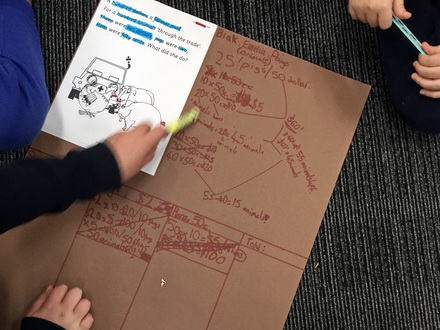
OMG Ellen, I wish you had a live feed into my room. I just introduced the 100 animals for $100 poster problem (Maths 300), and it was amazing, going through the process, they really slowed down this week, but you still had a few who wanted to dive into solving it. The conversations and mathematical language and problem solving being used was incredible, they were really frustrated and they loved it. I told them it is good they were frustrated, because if this was easy it wouldn't be a problem, they were soooo engaged.
I asked permission from Ellen and Jane to use this quote and the email conversation continued...
I am happy for you to use it and I will send photos...
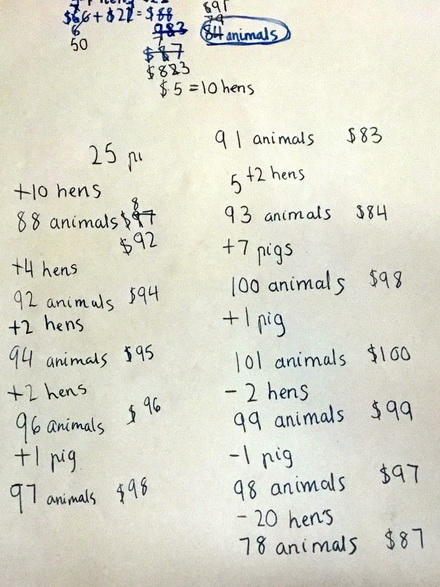
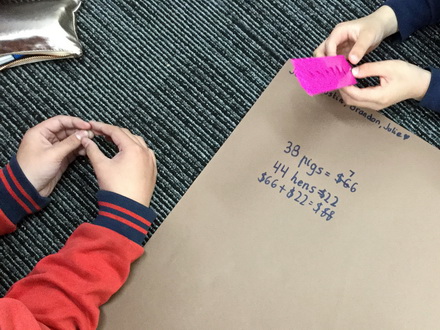
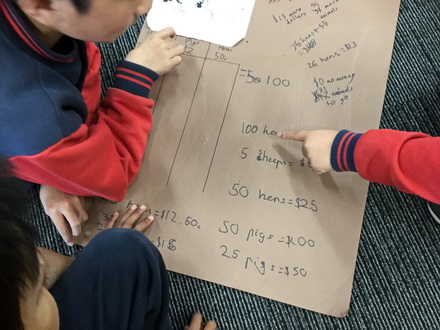
They were even more annoyed with me today, one group got 98 animals for $100 and they said "Jane. It's not fair." Another group asked if they could have half an animal, lol. I said no of course, they had to be live animals. 1 group worked with the ES staff member in my room, and although they haven't come up with a solution yet, the mathematical language they used to explain their thinking just blew me away, I'm talking low functioning children here which I find very difficult to engage, so it has been wonderful to see how hard they are working. We will continue this tomorrow so we will see how popular I am by the end of tomorrow.
The next day came...
Here are the photos. The lesson ended the way it started, with lots of very frustrated, but engaged and interested children. No group found a solution but everyone got very close. I was reflecting on it later and I was actually glad they didn't find a solution, because it made them focus more on the problem solving process rather than finding an 'answer', which I find very frustrating as a teacher. I try to instill that we value their thinking and how they find the answer rather than the actual answer. I teased them a bit and said I wasn't going to show them the solution, they were begging me to show the answer, so funny, so we worked through it together. The most satisfying outcome for me was that they asked if they could take it home to see if their parents could do it. I was over the moon as we are always trying to engage parents in their children's learning at our school. I had stories about dads skipping dinner to try and work it out and others cheating and going online to find a solution. I am expecting a few angry parents at my door over the next few days, I hope.
- Fascinated, captivated, absorbed? I think so.
- Learning to work like a mathematician? I think so.
What do you think?
|
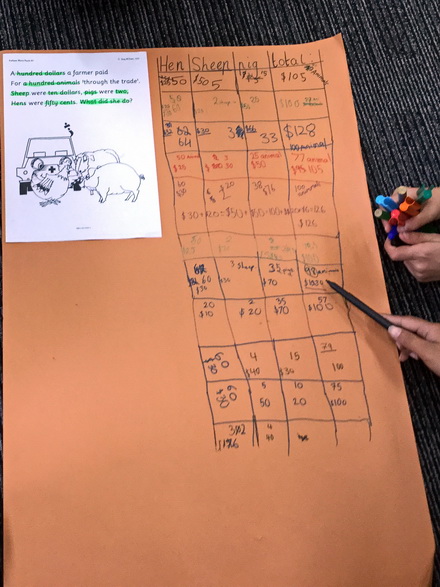
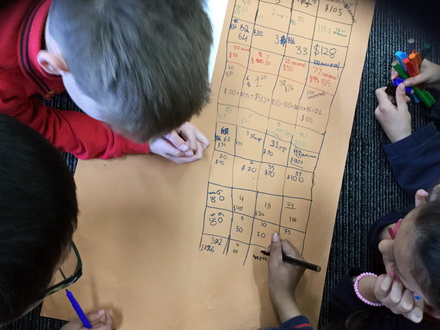
For more information about the Poster Problem Clinic see
Link List below.
|
- Per Finds World's Largest Sphinx (?)
 |
Hej to our Swedish readers who are in the early days of the new school year. Summer is over and the education fun has begun. Remember Per Berggren och Maria Lindroth can help you with professional development and resources through Kul Matematik. See Link List below for contact details.
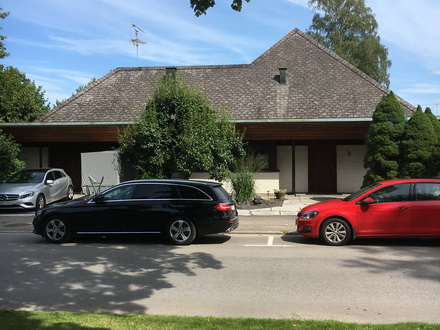
These two love their maths teaching and think about it almost all the time. The evidence is this photo from Älmhult which Per sent in the middle of his summer holiday. Could this roof line be the world's largest Sphinx shape?
- If so, how do you know?
- If not, why not?
- What might the roof look like on the unseen side? Could you sketch or construct it?
- Suppose someone actually did build a house with a vertical sphinx side similar to this roof. Design the house.
|
- New To Maths300?
 |
New to Maths300 and looking for a place to begin? The best advice is to choose a lesson, research and discuss it with colleagues, then try it with your kids and evaluate it together. But, how to choose the lesson?
There are tools on site.
- Use the Lesson List on the Members page and resort using the 'sorting triangles' at the top of each column.
- Use the Search Engine (top right of Members Page) and set the sort criteria to suit yourself.
- Use the Stage 2 Lessons list (also on the Members Page). These lessons offer refreshed layout and include a list of relevant Australian Curriculum outcomes and, if contributed, a link to Classroom Contributions.
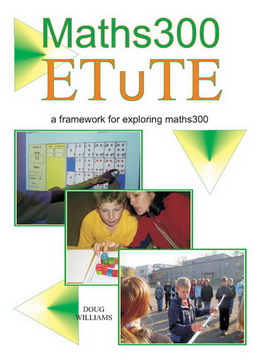
You could also use Maths300 ETuTE. Each page is designed as a stimulus for faculty/year level discussion around a focus question and a related lesson. Read together, discuss, plan, trial, review. These tutorials can be used randomly, or in order, or accessed through the Year Level or Content Finder pages at the end of the book.
See Link List below.
|
- Get to Know a Cameo
Task 183, Pizza Toppings
| It is amazing that such a simple looking task can open up such a deep investigation. The context of making or eating pizza is familiar to most students. I have even been invited to help deliver pizza around Milikapiti, Melville Island, on a Friday evening. It was flown in from Darwin and was still warm. For further confirmation of the interest the problem can generate, consider Oliver's journal record in the article Recording at Ashburton Primary School. See Link List below.
Perhaps because of this 'old friend' context the task initiates interest, then at all levels from Years 2 - 12 it is possible to uncover more and more depth in the iceberg. From
|
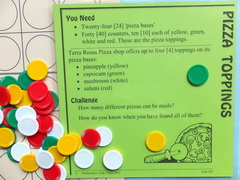 |
physically making as many pizzas as possible using counters, to asking What happens if...?, to seeking and seeing patterns, to linking the patterns to Pascal's Triangle, to exploring the expansion of (1 + x)t, t = no. of toppings, and relating its coefficients to the patterns in the problem.
The cameo explains all of this and more and strongly supports turning the task into a whole class investigation if you choose to use that life. Further, if you are a member of Maths300, Lesson 74, Pizza Toppings, offers additional support.
Keep smiling,
Doug.
Link List
- Did you miss the Previous News?
If so you missed information about:
- 25 Years Support
- 15 Years Support
- New Contact Details
- Conference for Gippsland Teachers
- Photographs Page Updated
- Get to Know a Cameo ... Doctor Dart
- ...and more...
|
 |
Did You Know?
|

Previous News
June 2017 ... May 2017 ... April 2017 ... February 2017
December 2016 ... November 2016 ... October 2016 ... September 2016 ... August 2016
July 2016 ... June 2016 ... May 2016 ... March 2016 ... February 2016
November 2015 ... October 2015 ... September 2015 ... August 2015
July 2015 ... June 2015 ... May 2015 ... April 2015 ... February 2015
Dec. 2014/Jan. 2014 ... November 2014 ... October 2014 ... September 2014 ... August 2014
July 2014 ... June 2014 ... May 2014 ... April 2014 ... March 2014 ... February 2014
Dec. 2013/Jan. 2014 ... November 2013 ... October 2013 ... September 2013 ... August 2013
July 2013 ... June 2013 ... May 2013 ... March 2013 ... February 2013
Dec. 2012 / Jan. 2013 ... November 2012 ... October 2012 ... September 2012 ... August 2012
June/July 2012 ... May 2012 ... April 2012 ... March 2012 ... February 2012 ... January 2012
December 2011 ... November 2011 ... October 2011 ... September 2011 ... August 2011
July 2011 ... June 2011 ... May 2011 ... April 2011 ... March 2011 ... February 2011
Dec 2010/Jan 2011 ... November 2010 ... October 2010 ... September 2010 ... August 2010
July 2010 ... June 2010 ... May 2010 ... April 2010 ... March 2010 ... February 2010
Dec.2009/Jan.2010 ...November 2009 ... October 2009 ... September 2009 ... August 2009
July 2009 ... June 2009 ... May 2009 ... April 2009 ... March 2009 ... February 2009
Dec.2008/Jan.2009 ... November 2008 ... October 2008 ... September 2008 ... August 2008
July 2008 ... May/June 2008 ... April 2008 ... March 2008 ... February 2008
Dec.2007/ Jan.2008 ... November 2007 ... October 2007 ... August/September 2007
... July 2007 ... June 2007 ... May 2007 ... April 2007 ... March 2007 ... February 2007
Dec. 2006/ Jan. 2007 ... November 2006 ... October 2006 ... September 2006 ... August 2006
July 2006 ... June 2006 ... May 2006 ... April 2006 ... March 2006 ... February 2006
Dec. 2005/ Jan. 2006 ... November 2005 ... October 2005 ... September 2005 ... August 2005
July 2005 ... June 2005 ... May 2005 ... April 2005 ... March 2005 ... February 2005
Dec. 2004/Jan. 2005 ... November 2004 ... October 2004 ... September 2004 ... August 2004
July 2004 ... June 2004 ... April/May 2004 ... March 2004 ... February 2004
December 2003 ... October 2003 ... August/September 2003
July 2003 ... June 2003 ... April/May 2003 ... March 2003 ... February 2003 ... January 2003
December 2002 ... November 2002 ... October 2002 ... September 2002 ... March 2002
December 2001 ... October 2001
Continue exploring our history back to July 1992 through the Sense of History link.
|