

Character #302: 见 jiàn
3 Lessons


Make a Movie 见
KEYWORD:
To See
Pinyin:
jiàn
Actor:
ji-
Set:
-an
Room within Set:
Bathroom or Backyard
Prop(s):
匚 (Cardboard Box)
儿 (Human Legs - Distorted!)
Notes:
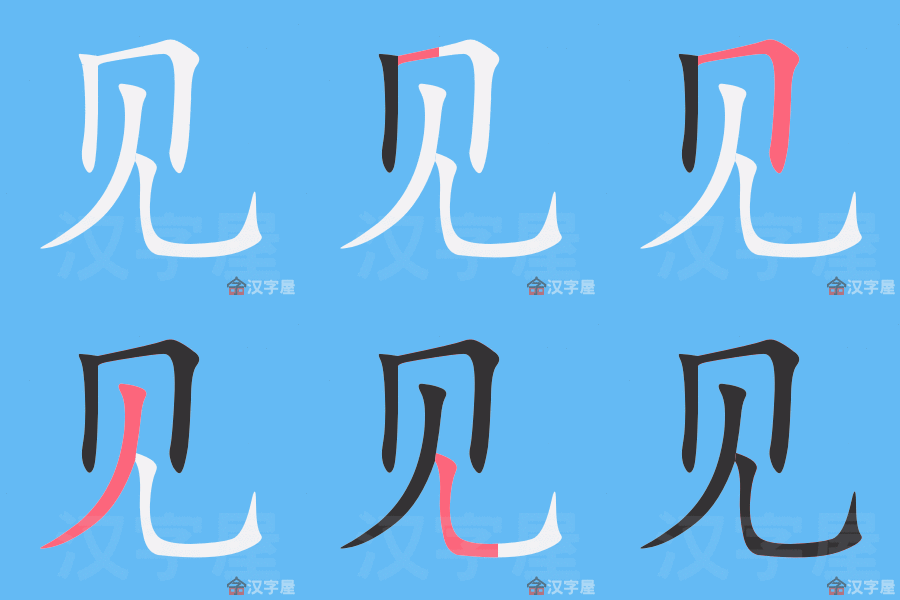
Just like how 贝 was a distortion of 目, so is 见, with the only difference being that instead of animal legs, we have human legs making up the 3rd & 4th stroke.
Member Comments from 2019-mid-2020
Do you also want to leave a comment? You can do so below!
Tyson
This scene relies on it's comedic feeling.
I'm in the backyard of my -an set with my Ji- actor. She thinks that she saw the cardboard box behind me move, and she's also thinks that she caught a glimpse of two legs moving it!
"Did you see that?" "See what?"
It happens again. "You didn't see that?!??" "See what?"
"How could you not see that?!?"
Etc.MB Team
This is where Luke & Phil talked about your question in the Mandarin Blueprint Podcast:
https://www.youtube.com/watch?v=9zm4Vy8mtfA&t=5106s
Chad Ressler
Location: Grandma's House (Backyard)
Actor: Janice (Stepmom)
Props: Eye of Sauron and Human Legs
I'm visiting with my Dad and Stepmom in the backyard of my Grandma's house. The Eye of Sauron is looming in the distance and has it's eye fixed on our house. Suddenly, there is a large gust of wind and my stepmom Janice is pulled into the Eye of Sauron and all we can see are her legs all distorted sticking out from below the Eye and then they sky becomes black as night. Light appears and, then, Mike Wazowski descends from the sky shouting "Did you SEE that transformation".Mandarin Blueprint
Here's the link to where Phil & Luke talked about this comment in the Mandarin Blueprint Podcast: https://youtu.be/n9Ae1W7m3no?list=PL_T_LpTzhQ1ihGzQaTSeYEvr8_jmImnO-&t=1221
Image credit: https://www.hanzi5.com
Comments 8


Click Here to Search Individual Hanzi 汉字
PHASE 1 (Levels 1-6)
- The Basics - Why Does This Method Work?
- How our Pinyin Chart is Different
- What are Chinese Characters?
- Props
- Sets
- Actors
- Scripts
- Inspiration for Scripts
- Special Effects
- Timeboxing
- Why SRS is So Important: Frequency & Memory
- How to Use SRS
- Habit Building Part 1 - Triggers
- Habit Building Part 2 - Routine
- Habit Building Part 3 - Reward
- Habit Building Part 4 - Belief
- Stroke Order Rule #1
- Stroke Order Rule #2
- Stroke Order Rule #3
- Stroke Order Rule #4
- Stroke Order Rule #5
- Stroke Order Rule #6
- Stroke Order Rule #7
- Stroke Order Rule #8
- Stroke Order Rule #9
- Stroke Order Rule #10
- Stroke Order Rule #11
- Stroke Order Rule #12
PHASE 2 (Levels 7-12)
- Understanding Chinese Words - Morphemes
- The Six Steps to Learning Words
- 3 Questions About Words
- Top-Down & Bottom-Up Learning
Living Links Series
Word Structure Series
- Part 1 - What are Chinese Words?
- Part 2 - Verb-What 述宾式
- Part 3 - Verb-How 补充式
- Part 4 - Biased 偏正式
- Part 5 - Parallel 并列式
- Part 6 - Duplicated 重叠式
- Part 7 - Subject-Predicate 主谓式
- Part 8 - Affixed 附加式
PHASE 3 (Levels 13-20)
- The Basic Chinese Sentence
- Helper - Expressing Possession with 的
- Helper - When You Can Omit 的
- Helper - Completed Actions with 了
- Helper - Change of State with 了
- Helper - Present Actions with 着
- Connector - Saying 'But' with 但是 - 可是 - 不过
- Connector - Reasons & Actions with 因为..., 所以...
- Connector - Conditional "If-Then" Statements with 如果..., 就
- Connector - Conditional "If-Then" Statements with 要是...的话
- Connector - "Or" in Questions with 还是
- Connector - “Or" in Statements with 或/或者
- Relator - Using 为 to Express "For"
- Relator - Expressing "From" with 从
- Relator - Expressing Location with 在
- Special - Using 在 as a Verb
- Tone - Softening Tone of Voice with 呢
- “How Does What" - Adverbs of Denial
- “How Does What" - Adverbs of Degree
PHASE 4 (Levels 21-30)
Level 21
- Transferring Money by Smartphone or Bank
- Walk in the Park?! I Have 汉字 to Study!
- Who Determine's a Baby's Looks, Mom or Dad?
Level 22
- How Many Pages of the Book Have You Read?
- Many People Don't Want to Have Babies
- My Girlfriend Can Really Eat!
- What Do You Like to Do?
- What Method Works for Learning Chinese?
Level 23
- Eating Bread
- I Met My Girlfriend in the Park
- Something is Different About My Dog Lately
- The Older Brother is Better Than the Younger Brother
- The Right and Left Side of the Office
- Three Meals a Day
Level 24
- Annoying People
- Breaking Up at the End of the Date
- Going on a Date
- My Two Friends and I
- Overtime at Work
- Red Packets
- Two People in a Relationship
Level 25
- I Want to Find a Boyfriend Too
- My Dad and I
- My Dog Chouchou
- The Big Changes of China
- The Weather is Great, Let's Go to the Park!
- Xiaomei and Her Boyfriend's Day
Level 26
Level 27
- American Journalist Studies Chinese in China
- Can I Still Learn Chinese Anymore?
- Should I Change?
- Children and Their Parents
- Foreigner's Opinion of China
- What Do You Want to Be When You Grow Up?
Level 28
- Daughter & Mother
- Son's Eighth Birthday
- Study, Work & Life
- What's More Important, Looks, or Ability?
Level 29
- Advertisements
- Buying Tickets at Chinese New Year
- Everybody Restaurant
- How Does One Progress
- Son is Out of Control
Level 30
- Cars, Bicycles & Trains
- Potatoes & Beef
- Two Ladies Compare Who's Got it Better
- Young People Raising Cats and Dogs
Phase 4 Grammar Points

Get Involved!
Have any questions about the course? Want to share an interesting "movie scene?" How about an Actor, Set or Prop? Just leave a comment below the lesson in question and we'll talk about it in our weekly podcast!

Keep on learning with us!
We make frequent blog updates that will make you SUPER motivated as you keep climbing the "acquisition mountain." Check it out and subscribe!
Keith Wilkens
Just wondering about the difference between 见 and 看 when used as a verb? I've referred to pleco, but the difference still seems kind of subtle. Is it just a case of knowing when to use each based on context?
Mandarin Blueprint
You'll definitely get the hang of these two, but here's a quick area where they aren't the same: 见 is sometimes used as a result but 看 is not. For example, 看见 means to "look" and "see (successfully)." It works the same way as "看到." 听见 tīngjiàn works in the same way, "hear 听" plus "success 见." 看 is never used in this way. However, 见 can sometimes be used similarly as a verb to 看.
Not to worry, though, with enough input this will all naturally clarify itself.
若渤 汤
Jane is standing in the kitchen of my apartment in Dublin (an set). She has a large CARDBOARD BOX over her head, and so she cannot SEE. All I can SEE of her are her LEGS sticking out the bottom of the cardboard box. But she is complaining loudly that she cannot SEE, so there is no doubt that this is Jane in there. I carefully pierce two holes in the cardboard box so that she can SEE through them. Jane's protests subside, slightly.
Jeff Bryant
Someone playing peekaboo, I SEE you! with a cardboard box that covers herself down to her legs.
John Nomura
In the an- set bathroom Julia Roberts (ji- actor) lifts up the box (匚) and was shocked to SEE (见) human legs; she was expecting to see a shellfish (贝) with animal legs
Anne Giles 🤝
@John Nomura Another helpful scene. Thanks!
Jason Pon
Wait... so do we use the box prop or 目as the top part. The props say box, but your caption says it is the same as the distorted eye. For consistency, I think I'm going to go with the distorted eye :) Especially since it means 'see'
Mandarin Blueprint
You can do either, whatever helps you remember most easily :).