Dechatter Filter
Original instructions
Overview
CAUTION
UNEXPECTED APPLICATION BEHAVIOR – INCORRECT INTERPRETATION OF INPUT DATA
Dechatter filters are used to suppress the input recognition in a defined way. Filtering should only be used in a suitable way to prevent too much or undesired suppression of input data.
Failure to follow these instructions can result in injury or equipment damage.
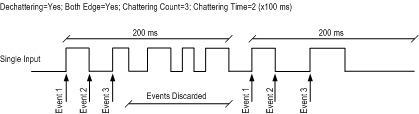
The dechatter function limits the number of events within a configurable value during a configurable time period. This filter reduces the number of event registrations for the same input so that events, such as low slew rate inputs, do not disturb the recording of desired events.
The dechatter filter requires the following two configurable parameters: Chatter Counter (C): This value defines the first count (C) number of edges recorded. Edges received after this count (C) reached within a specified duration (T) are discarded. The value range is from 1...255. Chatter Time (T): This value defines the duration for chatter time. The first rising or falling edge (or, the first edge after the end of last (T) confirms the beginning of current chatter time. Within the configured (T) only (C) number of edges is recorded. The value range is 1...255 where each number represents an unit of 100 ms (that is, 0.1...25.5 s).
The following figure shows the dechatter filter:
The following table describes the parameters and is provided with enable bit to activate or deactivate the dechatter filter:
Parameter Type
Parameter Symbol
Valid Values
Unit
Description
Configuration
Chatter count
1...255 (default: 1)
Effective range
Channel
Organization
Each group
Configuration
Chatter time
1...255 (default: 1)
100 ms
Effective range
Channel
Organization
Each group
Configuration
Dechatter filter
0: Disable
1: Enable
(default: 1)
Effective range
Group
Organization
Each group
Implicit
Dechatter active
0: Inactive
1: Active
Available in:
  • Device DDT
  • IODDT
  • Debug screen
The dechatter active bit describes the status of dechatter filter.
When an edge is discarded by dechatter filter, the dechatter active bit is set to 1 and is cleared at the end of current (T) duration.
NOTE: With the enabled dechatter filter and certain condition of input pattern, a recorded rising edge can be followed by another rising edge recorded (as shown in the previous figure), or a recorded falling edge can be followed by another falling edge recorded.