





Level 30 Complete, Phase 4 Complete!
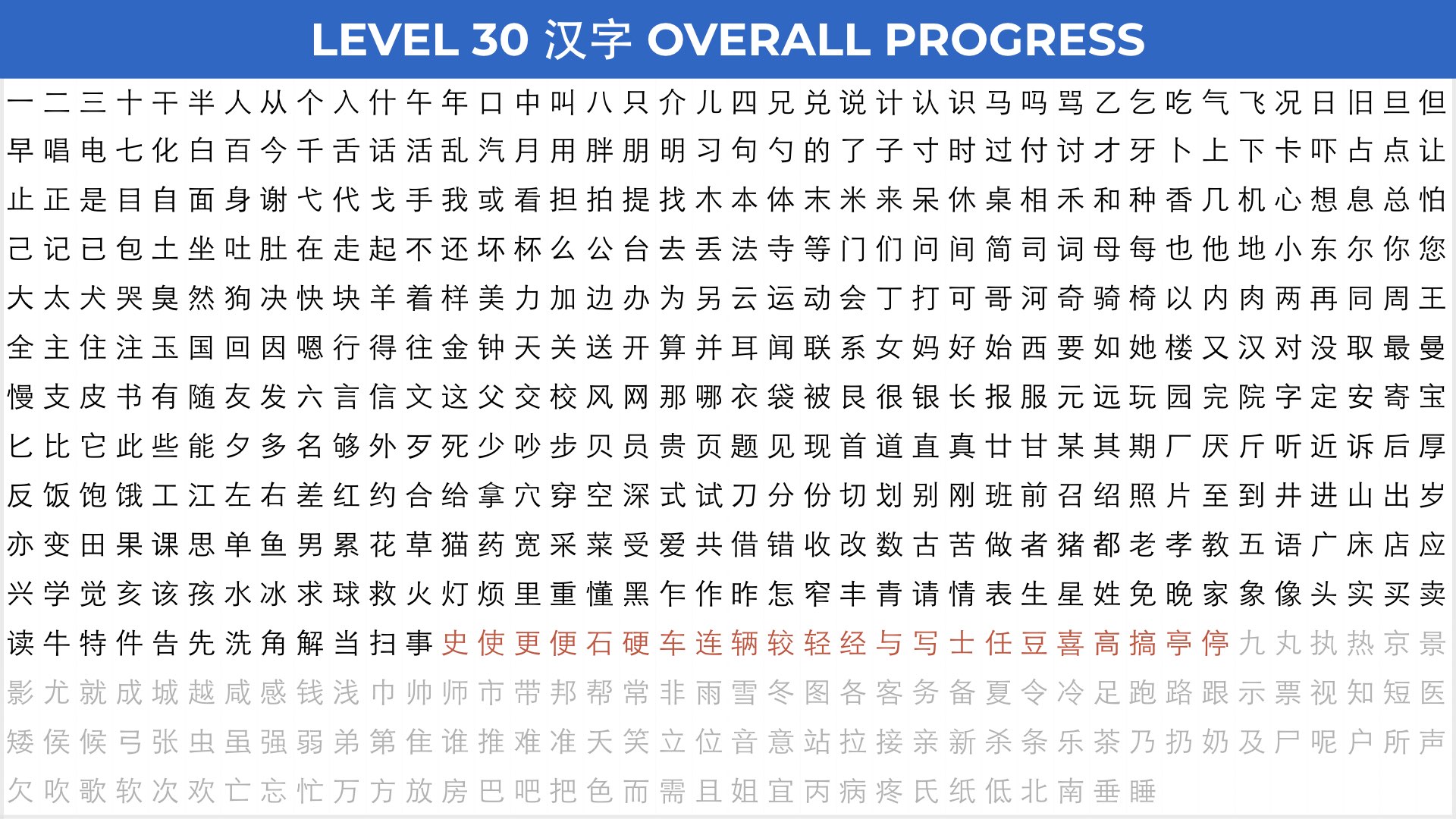
Click Here to See Your Overall Character & Word Learning Progress
(The text from this lesson is also sent to your email after you click "lesson complete." If you didn't receive the email, it may be because you have email notifications turned off. Here's a video on how to update your email settings.)
Phase 4搞定了!
搞定 isn’t a high-frequency word (although it’s pretty close). Betcha can figure out what it means, though. After all, 搞 is a verb you just learned, and we know that 定 can be a result. You ‘took care of’ (搞) until it was ‘confirmed’ (定). In short, it means “Check! Done!”
Phase 5 Coming Up
天哪!OMG! Now that you’ve finished Phase 4, you’re ready to enter into what is effectively the final broad phase of learning Chinese. Phase 5 is all about stories, and everything from newspaper articles to novels is (at least in some way) trying to convey a story. The reason that this is such a huge step is that you’re exiting the “fundamentals” stage and entering into the “getting good” stage.
You’re Reaching the Point Where Chinese is Not the Focus, But Rather The Avenue
Up until now, the vast majority of what you’ve been learning is about the Chinese language in and of itself. However, once you start reading stories, you open up the possibility for Chinese to merely be the avenue by which you acquire new knowledge. Holy heck.
When the two of us started listening to the 罗辑思维 luóji sīwéi (‘Logical Thinking’ with the 逻 in 逻辑 luóji changed to the host’s surname 罗) podcast, we started learning about philosophy, economics, history, and much more via the avenue called 'Chinese.' Any Chinese acquisition was incidental (although massively sped up). You’re so close to reaching that level. Just keep showing up every day.
Some Level 30 Awesomeness - 车 & Word Structure
First of all, 车 means “vehicle” more than it means “car.” 汽车 is an automobile, whereas 车 by itself is a catch-all word for vehicles that travel along the ground with wheels. You find out which type of vehicle it is either through context (e.g., you’re looking at the 电动车 in front of you and a repairman, so he knows you don’t mean “car” when you say ‘我的车坏了‘), or by using one of the many biased words that specify the type of vehicle.
自行车 ‘self’ - ’to go’ - ‘vehicle.’ Heck, a vehicle you power forward by yourself? Duh, a bicycle.
火车 - ‘fire’ - ‘vehicle.’ OK, so it’s a legacy word because *trains* don’t run on fire-burning engines anymore, but they did when the word was invented!
电动车 ‘electric’ - ‘move’ - ‘vehicle’ - *eBikes* sure do use electricity to make the vehicle move!
Isn’t Chinese easy? Now let’s look at a few of the ‘Verb-What’ structures that 车 gave us:
打车 - Verb: ’to hail’ Hail What? A 车.
开车 - Verb: ‘to drive.’ Drive What? A 车.
上车 - Verb: ‘to get on or in.’ Get in What? A 车.
下车 - Verb: ‘to get off or out.’ Get out of what? A 车.
Legacy Words
Unsurprisingly, 上 & 下 are used with when referring to getting in or out of cars as opposed to 外 & 里. Why? Because the earliest cars were much like carriages. They didn’t have an “inside” as much as a seat on wheels that was above (上) the ground. That’s even how you refer to things that are in your car. For example, if your “bag is in the car,” you’d say “我的包在车上.”
Sure, this can be frustrating sometimes when you are trying to be intuitive (i.e., the bag is “in” the car, so shouldn’t it be 里?), but it also exemplifies just how beautifully efficient the Chinese language is. When there is a new invention, the process of inventing a new word must get at the crux of the invention’s nature.
For example, after drones became a ubiquitous way to shoot videos (and, sigh, practice warfare), someone in China said, “Heck, what should we call this thing? Well, it’s definitely a machine (机), but there aren’t (无 wú) any people (人 rén). How about a 无人机?" Sure, that doesn’t tell you everything about it, but it gives you a quick overview. Chinese is wicked!
You’re Going to Win
You’ve been stepping up to the challenge every day for a while now. Did any part of you think you couldn’t do it? Did anyone you know look askance when you told them what you were up to? You’re not finished learning, but the doubt is gone. Victory isn’t a moment; it’s something you’ve been doing every day and will continue to do for years to come.
Not that it’s important, but we unabashedly & unreservedly admire you. Thank you for believing in our course and contributing to a better connection between the West and China. Absolute hero.
保重,
Luke & Phil

Comment 1




Click Here to Search Individual Hanzi 汉字
PHASE 1 (Levels 1-6)
- The Basics - Why Does This Method Work?
- How our Pinyin Chart is Different
- What are Chinese Characters?
- Props
- Sets
- Actors
- Scripts
- Inspiration for Scripts
- Special Effects
- Timeboxing
- Why SRS is So Important: Frequency & Memory
- How to Use SRS
- Habit Building Part 1 - Triggers
- Habit Building Part 2 - Routine
- Habit Building Part 3 - Reward
- Habit Building Part 4 - Belief
- Stroke Order Rule #1
- Stroke Order Rule #2
- Stroke Order Rule #3
- Stroke Order Rule #4
- Stroke Order Rule #5
- Stroke Order Rule #6
- Stroke Order Rule #7
- Stroke Order Rule #8
- Stroke Order Rule #9
- Stroke Order Rule #10
- Stroke Order Rule #11
- Stroke Order Rule #12
PHASE 2 (Levels 7-12)
- Understanding Chinese Words - Morphemes
- The Six Steps to Learning Words
- 3 Questions About Words
- Top-Down & Bottom-Up Learning
Living Links Series
Word Structure Series
- Part 1 - What are Chinese Words?
- Part 2 - Verb-What 述宾式
- Part 3 - Verb-How 补充式
- Part 4 - Biased 偏正式
- Part 5 - Parallel 并列式
- Part 6 - Duplicated 重叠式
- Part 7 - Subject-Predicate 主谓式
- Part 8 - Affixed 附加式
PHASE 3 (Levels 13-20)
- The Basic Chinese Sentence
- Helper - Expressing Possession with 的
- Helper - When You Can Omit 的
- Helper - Completed Actions with 了
- Helper - Change of State with 了
- Helper - Present Actions with 着
- Connector - Saying 'But' with 但是 - 可是 - 不过
- Connector - Reasons & Actions with 因为..., 所以...
- Connector - Conditional "If-Then" Statements with 如果..., 就
- Connector - Conditional "If-Then" Statements with 要是...的话
- Connector - "Or" in Questions with 还是
- Connector - “Or" in Statements with 或/或者
- Relator - Using 为 to Express "For"
- Relator - Expressing "From" with 从
- Relator - Expressing Location with 在
- Special - Using 在 as a Verb
- Tone - Softening Tone of Voice with 呢
- “How Does What" - Adverbs of Denial
- “How Does What" - Adverbs of Degree
PHASE 4 (Levels 21-30)
Level 21
- Transferring Money by Smartphone or Bank
- Walk in the Park?! I Have 汉字 to Study!
- Who Determine's a Baby's Looks, Mom or Dad?
Level 22
- How Many Pages of the Book Have You Read?
- Many People Don't Want to Have Babies
- My Girlfriend Can Really Eat!
- What Do You Like to Do?
- What Method Works for Learning Chinese?
Level 23
- Eating Bread
- I Met My Girlfriend in the Park
- Something is Different About My Dog Lately
- The Older Brother is Better Than the Younger Brother
- The Right and Left Side of the Office
- Three Meals a Day
Level 24
- Annoying People
- Breaking Up at the End of the Date
- Going on a Date
- My Two Friends and I
- Overtime at Work
- Red Packets
- Two People in a Relationship
Level 25
- I Want to Find a Boyfriend Too
- My Dad and I
- My Dog Chouchou
- The Big Changes of China
- The Weather is Great, Let's Go to the Park!
- Xiaomei and Her Boyfriend's Day
Level 26
Level 27
- American Journalist Studies Chinese in China
- Can I Still Learn Chinese Anymore?
- Should I Change?
- Children and Their Parents
- Foreigner's Opinion of China
- What Do You Want to Be When You Grow Up?
Level 28
- Daughter & Mother
- Son's Eighth Birthday
- Study, Work & Life
- What's More Important, Looks, or Ability?
Level 29
- Advertisements
- Buying Tickets at Chinese New Year
- Everybody Restaurant
- How Does One Progress
- Son is Out of Control
Level 30
- Cars, Bicycles & Trains
- Potatoes & Beef
- Two Ladies Compare Who's Got it Better
- Young People Raising Cats and Dogs
Phase 4 Grammar Points
Get Involved!
Have any questions about the course? Want to share an interesting "movie scene?" How about an Actor, Set or Prop? Just leave a comment below the lesson in question and we'll talk about it in our weekly podcast!

Keep on learning with us!
We make frequent blog updates that will make you SUPER motivated as you keep climbing the "acquisition mountain." Check it out and subscribe!
Jonathan Pritchard
Onward and upward!