

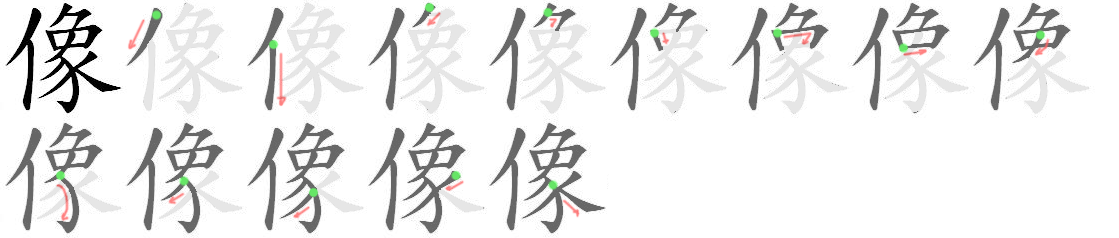
Character #436: 像 xiàng
2 Lessons
Make a Movie 像
KEYWORD:
To Look Like
Pinyin:
xiàng
Actor:
xi- Female
Set:
-ang
Room within Set:
Bathroom or Backyard
Prop(s):
亻 Chuck Norris
象 Elephant
Member Comments from 2019-mid-2020
Do you also want to leave a comment? You can do so below!
Bel Hermawan
Shakira (xi-) has hung up a green screen in the large bathroom/locker-room of my -ang school set. She is wanting her new music video to be set in the jungle, but there are travel restrictions at the moment. Chuck Norris and an elephant from the zoo have been brought in, but instead of getting ready, Chuck stands to the side and angrily questions Shakira about the cheap looking production set. Shakira says not to worry because the studio will ensure the green screen is made TO LOOK LIKE the jungle. The elephant trumpets at Chuck and pokes him in the back with it's trunk – it just wants to film the music video quickly and go back to the zoo! Chuck angrily kicks at the air and gets back to work.
Image credit: CC BY 3.0 (https://creativecommons.org/licenses/by/3.0)], via Wikimedia Commons
Comments 5


Click Here to Search Individual Hanzi 汉字
PHASE 1 (Levels 1-6)
- The Basics - Why Does This Method Work?
- How our Pinyin Chart is Different
- What are Chinese Characters?
- Props
- Sets
- Actors
- Scripts
- Inspiration for Scripts
- Special Effects
- Timeboxing
- Why SRS is So Important: Frequency & Memory
- How to Use SRS
- Habit Building Part 1 - Triggers
- Habit Building Part 2 - Routine
- Habit Building Part 3 - Reward
- Habit Building Part 4 - Belief
- Stroke Order Rule #1
- Stroke Order Rule #2
- Stroke Order Rule #3
- Stroke Order Rule #4
- Stroke Order Rule #5
- Stroke Order Rule #6
- Stroke Order Rule #7
- Stroke Order Rule #8
- Stroke Order Rule #9
- Stroke Order Rule #10
- Stroke Order Rule #11
- Stroke Order Rule #12
PHASE 2 (Levels 7-12)
- Understanding Chinese Words - Morphemes
- The Six Steps to Learning Words
- 3 Questions About Words
- Top-Down & Bottom-Up Learning
Living Links Series
Word Structure Series
- Part 1 - What are Chinese Words?
- Part 2 - Verb-What 述宾式
- Part 3 - Verb-How 补充式
- Part 4 - Biased 偏正式
- Part 5 - Parallel 并列式
- Part 6 - Duplicated 重叠式
- Part 7 - Subject-Predicate 主谓式
- Part 8 - Affixed 附加式
PHASE 3 (Levels 13-20)
- The Basic Chinese Sentence
- Helper - Expressing Possession with 的
- Helper - When You Can Omit 的
- Helper - Completed Actions with 了
- Helper - Change of State with 了
- Helper - Present Actions with 着
- Connector - Saying 'But' with 但是 - 可是 - 不过
- Connector - Reasons & Actions with 因为..., 所以...
- Connector - Conditional "If-Then" Statements with 如果..., 就
- Connector - Conditional "If-Then" Statements with 要是...的话
- Connector - "Or" in Questions with 还是
- Connector - “Or" in Statements with 或/或者
- Relator - Using 为 to Express "For"
- Relator - Expressing "From" with 从
- Relator - Expressing Location with 在
- Special - Using 在 as a Verb
- Tone - Softening Tone of Voice with 呢
- “How Does What" - Adverbs of Denial
- “How Does What" - Adverbs of Degree
PHASE 4 (Levels 21-30)
Level 21
- Transferring Money by Smartphone or Bank
- Walk in the Park?! I Have 汉字 to Study!
- Who Determine's a Baby's Looks, Mom or Dad?
Level 22
- How Many Pages of the Book Have You Read?
- Many People Don't Want to Have Babies
- My Girlfriend Can Really Eat!
- What Do You Like to Do?
- What Method Works for Learning Chinese?
Level 23
- Eating Bread
- I Met My Girlfriend in the Park
- Something is Different About My Dog Lately
- The Older Brother is Better Than the Younger Brother
- The Right and Left Side of the Office
- Three Meals a Day
Level 24
- Annoying People
- Breaking Up at the End of the Date
- Going on a Date
- My Two Friends and I
- Overtime at Work
- Red Packets
- Two People in a Relationship
Level 25
- I Want to Find a Boyfriend Too
- My Dad and I
- My Dog Chouchou
- The Big Changes of China
- The Weather is Great, Let's Go to the Park!
- Xiaomei and Her Boyfriend's Day
Level 26
Level 27
- American Journalist Studies Chinese in China
- Can I Still Learn Chinese Anymore?
- Should I Change?
- Children and Their Parents
- Foreigner's Opinion of China
- What Do You Want to Be When You Grow Up?
Level 28
- Daughter & Mother
- Son's Eighth Birthday
- Study, Work & Life
- What's More Important, Looks, or Ability?
Level 29
- Advertisements
- Buying Tickets at Chinese New Year
- Everybody Restaurant
- How Does One Progress
- Son is Out of Control
Level 30
- Cars, Bicycles & Trains
- Potatoes & Beef
- Two Ladies Compare Who's Got it Better
- Young People Raising Cats and Dogs
Phase 4 Grammar Points
Get Involved!
Have any questions about the course? Want to share an interesting "movie scene?" How about an Actor, Set or Prop? Just leave a comment below the lesson in question and we'll talk about it in our weekly podcast!

Keep on learning with us!
We make frequent blog updates that will make you SUPER motivated as you keep climbing the "acquisition mountain." Check it out and subscribe!
Anne Giles 🤝
Two questions.
1) In English, when comparing two things, some things are considered similar and some things are considered interchangeable. A simile expresses a comparison between two things that are similar, often using "like" or "as": "Anger is like a full-hot horse, " and "Fluent as the sea." A metaphor expresses the idea that two things ARE each other: "Juliet is the sun." Does this concept - that some things are like each other vs. some things ARE each other - exist in Chinese?
2) When comparing two things as like each other, it seems as if we have two choices: 一样 yīyàng (Level 16) or 像 xiàng (Level 29).
Chinese Grammar Wiki offers this example using both:
我 像 你 一样 大 的时候,还 不 知道 手机 是 什么 。
Wǒ xiàng nǐ yīyàng dà de shíhou, hái bù zhīdào shǒujī shì shénme.
When I was as old as you are, I didn't know what a cell phone was.
Can you help disambiguate 像 and 一样? If so, thanks!
Mandarin Blueprint
The answer to the first question is helpful in understanding the second question. 像 is the "as" of a simile. 他像火一样生气 "He's as angry as fire." The object of the simile is what goes between 像 and 一样. As for metaphors, you'd simply use "是," like 水是力量 "water is power."
The answer to #2 is that 像 and 一样 are frequently used together, 像 just indicates that it's a simile. If instead of saying "我像你一样," I instead said "我和你一样," the only difference is that "A + 和 + B + 一样“ is a direct comparison, whereas “A + 像 + B + 一样“ is an abstract comparison of kind.
Anne Giles 🤝
WOW! That was fast, thorough, and helpful! 谢谢!
MB Team
This is where Luke and Phil talked about your question in the Mandarin Blueprint Podcast:
https://www.youtube.com/watch?v=Jaebh_qgjTQ&t=2527s
John Nomura
In the bathroom of my ANG- set, I see my xi- actor dressing up Mr. T TO LOOK LIKE Dumbo (象) e.g. big ears for flying & a cut little hat. Mr T looks very grumpy.