HiNPrecise
High-Multiplicity Scattering for a New Era of Precision at Particle Colliders
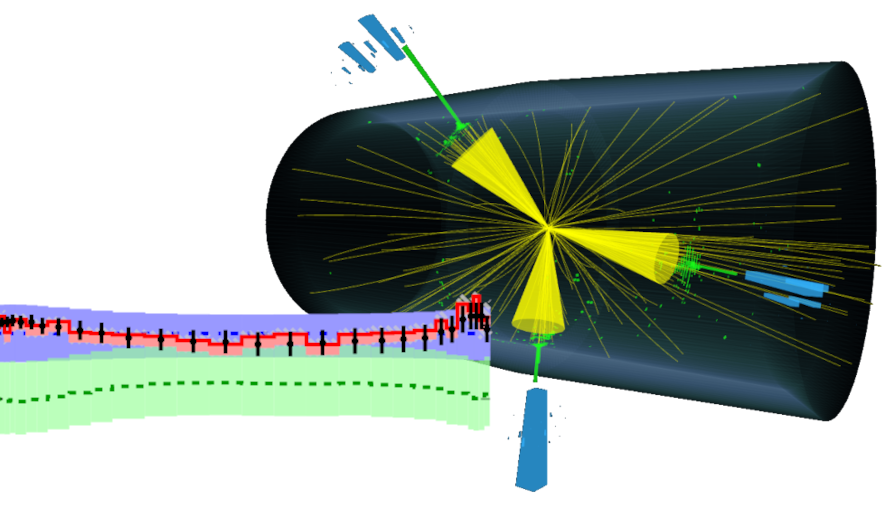
The Large Hadron Collider (LHC) at CERN explores the interactions of elementary particles at the most fundamental level. Upcoming upgrades to the LHC will significantly reduce statistical uncertainties, enabling measurements at percent-level precision. To fully exploit this level of precision, theoretical predictions must achieve comparable accuracy, which requires incorporating higher-order terms in the perturbative series in the strong coupling constant. Currently, only next-to-leading order terms can be included for arbitrary scattering processes, while higher-order corrections remain a significant challenge. A major obstacle is the complexity of high-multiplicity multi-loop scattering amplitude calculations.
HiNPrecise will overcome this challenge by developing an innovative computational framework that builds on insights into the physical and mathematical structure of scattering amplitudes and Feynman integrals. Guided by deeper understanding of the amplitudes' intricate analytic structure, the project will develop a new generation of analytic and numerical methods that make the physical singularities manifest throughout the computation, unlocking calculations that are currently impossible. In particular, HiNPrecise will pioneer methods to handle multi-loop high-multiplicity amplitudes involving massive virtual particles, a critical frontier for scrutinizing the Higgs boson and the mechanism of electroweak symmetry breaking. Furthermore, HiNPrecise will push the boundaries of numerical efficiency, ensuring that high-precision phenomenological studies for complex, high-multiplicity processes become the new state of the art. This will empower the high-energy physics community with the tools necessary to achieve percent-level theoretical precision at the LHC and future collider experiments.
This project is funded with ERC Starting Grant 2025.