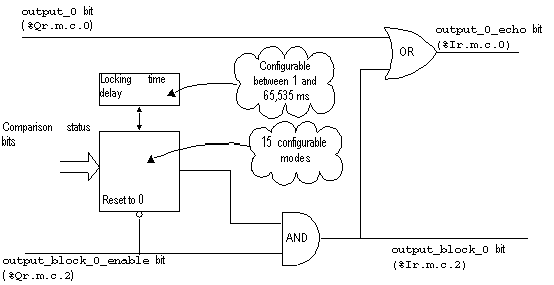
Every channel in the counting module has two programmable output blocks that operate with the comparison status register and affect the behavior of physical outputs Q0 and Q1.
There are two ways to control the output:
-
From the application: in this case, the output corresponds to the status of the output bit from the output command bit.
-
From the output function block: in this case, the user must enable the output block function. Then, the output corresponds to the status of the output bit from the function block.
The following figure shows the output function block Q0:
Use of the Function Block
Every physical output is controlled by two bits:
The output_block_0(1)_enable bit enables the operation of the function block 0(1) to be authorized when it is set to 1. When the bit is set to 0, Bit output_block_0(1) is maintained at 0.
The output_0(1) bit is applied at the logic output Q0(1) and must be set to 0 when the function block is used. When the bit is set to 1, the output is forced to 1.
In the operational modes where the block generates a pulse, the pulse width can be configured thanks to the configuration screen.
The table below shows the configurable functions:
|
Function code
|
Programming
|
|
0
|
Disabled = no direct action (Default value)
|
|
1
|
Low counter.
The output is high if the counter value is less than the low threshold.
|
|
2
|
Counter in a window
The output is high if the counter value is between the upper and lower thresholds or equal to one of the two thresholds.
|
|
3
|
High counter.
The output is high if the counter value is greater than the upper threshold.
|
|
4
|
Pulse less than the lower threshold.
The output pulse starts when the counter value decreases and crosses the lower threshold value -1.
|
|
5
|
Pulse greater than the lower threshold.
The output pulse starts when the counter value increases and crosses the lower threshold value +1.
|
|
6
|
Pulse less than the upper threshold.
The output pulse starts when the counter value decreases and crosses the upper threshold value -1.
|
|
7
|
Pulse greater than the upper threshold.
The output pulse starts when the counter value increases and crosses the upper threshold value +1.
|
|
8
|
Counter stopped (only in one shot counter mode).
The output changes to high if the counter is stopped.
|
|
9
|
Counter running (only in one shot counter mode).
The output changes to high if the counter is running.
|
|
10
|
Capture 0 low value.
The output is high if the capture 0 value is less than the lower threshold.
|
|
11
|
Capture 0 value in a window.
The output is high if the capture 0 value is between the upper and lower thresholds or equal to one of the two thresholds.
|
|
12
|
Capture 0 high value.
The output is high if the capture 0 value is greater than the upper threshold.
|
|
13
|
Capture1 low value.
The output is high if the capture1 value is less than the lower threshold.
|
|
14
|
Capture1 value in a window.
The output is high if the capture1 value is between the upper and lower thresholds or equal to one of the two thresholds.
|
|
15
|
Capture1 high value.
The output is high if the capture1 value is greater than the upper threshold.
|
NOTE: The output 0 function block is inactive when using the counter in pulse width modulation mode.
In general, these reflex actions act with a delay less than 0.6 ms. The repeatability is about +/- 0.3 ms.
Special boost functions:
Delay is less than 0.2 ms. The repeatability is about +/- 1 s.
The counting module BMX EHC 0200 enables output signals to be exchanged with two 24VCC field actuators.
It is possible to configure the following parameters for each output:
-
The module response for fault recovery
-
The output polarity for each counting channel (positive or negative polarity)
-
The fallback mode and state for every module channel
These three parameters are described in the following pages.
Outputs Q0 and Q1 are current limited (0.5 A maximum).
A thermal shutdown protects each output.
When a short-circuit is detected on one of the output channels, the counting module enables one of the two following actions according to the configuration:
-
fault recovery parameter configured as latched off: The counting module latches off the output channel
-
fault recovery parameter configured as autorecovery: The counting module latches off the output channel and automatically attempts to recover the error and to resume operation on the channel when the error is corrected.
In case of the fault recovery parameter is configured to latched off, if an output channel has been latched off because of short-circuit detection, the counting module recovers the fault upon the following sequence is processed:
-
The error has been corrected
-
You explicitly reset the fault: To reset the error, the application software must:
In case of the fault recovery parameter is configured to auto recovery, an output channel that has been turned off because of error detection starts operating again as soon as the error is corrected. No user intervention is required to reset the channels.
NOTE: A minimum delay of 10 s occurs before the error is cleared in both latched off and auto recovery modes.
Output Polarity Programming
It is possible to configure the polarity parameter for each output during the channel configuration:
-
polarity parameter configured as polarity +: The physical output is 24 VDC when the output is at the high level (output_0_echo = 1)
-
polarity parameter configured as polarity -: The physical output is 24 VDC when the output is at the low level (output_0_echo = 0)
By default, the two output channels are in positive polarity.
The fallback modes are the predefined states to which the output channels revert when the channel is not controlled by the processor (when communications are lost or when the processor is stopped for example).
The fallback mode of each output channel can be configured as one of the following modes:
NOTE: By default, the fallback mode of the 2 output channels is with and the fallback value parameter is 0.