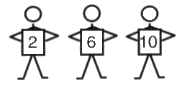
9 + 2 = 11
6 + 5 = 11
3 + 8 = 11
0 + 11 = 11
4 + 7 = 11
10 + 1 = 11

Collecting data, discussing, recording
It is most likely that pairs will be randomly distributed around the front of the room, so list their sums in the order they appear.
2.
| Have we got them all? How do we know? Can you convince me there are no more? |
The most common suggestion from students is to reorganise the data as follows:
0 + 11 = 11
1 + 10 = 11
2 + 9 = 11
3 + 8 = 11
4 + 7 = 11
5 + 6 = 11
... and after that they repeat, so there can't be any new ones
Problem posing, organising data, working in context, discussing
There is sometimes discussion about whether, for example, 2 + 9 = 11 is different, in the
context of the problem, to 9 + 2 =11. In this case, consider that the context of the problem is pairs not equations, but
point out that a divergent investigation could develop around allowing repeats.
3.
| What if we weren't restricted to 11? For example, how many whole number pairs are there which sum to 12? |
Allow discussion and record the agreed result.
| No. | Pairs | |
|---|---|---|
| 11 | -----> | 6 |
| 12 | -----> | 7 |
Problem posing
The question What if ...? is often a way into a new class of problems.
So in this case, ask the students to predict the number of pairs for 13.
4. Students (and teachers) commonly predict 8 pairs for the number 13. The teacher invites them to test this hypothesis. There is usually a rumble of surprise when the answer turns out to be 7 not 8.
Making & testing hypotheses
Not all hypotheses are correct!
5.
| Let's investigate the pairs for other numbers. |
Go around the class asking each student to choose a number and list these on the board as you go. eg:
17
23
16
1000 (It is desirable to test extremes.)
...
| Now, find out how many pairs for your number and come and record your answer on the board. |
Collecting data, making & testing hypotheses
Allow the students to tell you, and share with the class, that pairs for even numbers are slightly
different to those for odd numbers.
If there is dispute over particular results, try the question:
| Can you check it another way? |
| Well we've got a lot of data here. What do we have to do with it if we want to make sense out of it? |
Students should suggest organising it in order and will also perhaps ask that missing numbers in the
sequence now be investigated.
A pattern will begin to emerge, eg
1 -----> 1
2 -----> 2
3 -----> 2
4 -----> 3
5 -----> 3
...
Organising data, seeking & seeing patterns
7.
| Suppose the chosen number was 25? How many pairs? Suppose it was 50? How many pairs? Suppose the number of pairs was 20? What is the chosen number? Suppose we graphed these results - that is another way to organise data - can you predict the shape the graphed points would make? How can we test this prediction? |
Seeking & seeing patterns, making & testing hypotheses
Whenever a table such as that in Step 6 develops from an experiment there is the opportunity to:
8. Ask the students to do the worksheet. If they can work in pairs the mathematical conversation which develops can help the verbalisation of the pattern(s), which is necessary for the next stage.
Discussing, recording, making & testing hypotheses
The students quickly see the need for two cases; one for an odd chosen number and one for an even chosen number.
Different groups also arrive at different rules which involve variations on adding 1 and dividing by
two. There are, in fact, several valid rules and this is a good opportunity to point out that maths is
not necessarily the subject with one right answer to each question.
10.
| Mathematicians prefer to write in shorthand if possible. For example for the phrase 'any chosen number', they would use a letter like 'n'. Try to rewrite your sentence in shorthand using mathematical symbols rather than words. |
Two possible versions are:
Even: (n ÷ 2) + 1
... because you get all the pairs from 1 up to half way plus 1 for the zero pair.Odd: [n ÷ 2] + 1
... divide the number by 2 , forget the half and then add 1 for the zero pair.NB: [square brackets] can be used as the mathematical symbol for finding the whole, or integer, part of a number.
Recording
Several results are also possible when the rules are written in symbolic form.
Other versions are: ((n - 1) ÷ 2) + 1 or (n + 1) ÷ 2
Again, it is important to develop the symbolism from the students' suggestions rather than to impose a 'mathematician's view'.
11. Review and record the aspects of the Working Mathematically process which have been crucial to the exploration of this problem. Remind students that:
| ...we have used this process for many problems in our lessons because Working Mathematically is the subject we are learning. We are not only learning or practising mathematical content, but we are learning to work in the same way as the people who created the mathematical content. |
11 = 1 + 2 + 8How many combinations are there? How do you know when you have found them all?
11 = 3 + 3 + 5
...
Pose a new problem