|
Put Me In The Zoo

Years K - 3 |
Summary
Robert Lopshire, Collins Harvill, 1960
Cat In The Hat Beginner Book
ISBN 0 00 171119 9
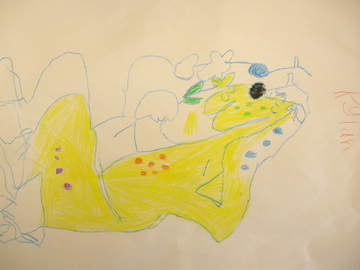
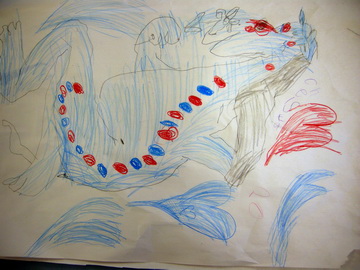
Young children enjoy this book and if you ask around the class it is very likely someone will provide a copy. Alternatively, it is easy to purchase on line. Use Google to find many sources. No doubt, even if you can't find the book, you can still build an investigation around the Spotty Creature below.
Being in rhyme, the story has extra appeal. Use it for all it is worth to encourage literacy. The description below explains how it came to be used as a source of mathematics learning. The ideas can, most certainly, be threaded.
|

|
Materials
- One Poly Plug per pair
- One calculator per pair
- One Spotty Creature per pair, enlarged to A3 if possible
Acknowledgement
This activity was first used at Clayton Elementary School, Denver, Colorado, USA.
Procedure
The book introduces us to an unnamed Spotty Creature who is desperate to be put in the zoo. Upon rejection from this preferred vocation the creature complains to two children that the zoo people don't know all the wonderful things it can do with its spots. For most of the book the creature then demonstrates remarkable spot feats which include changing colour and changing numbers...
... This was the 'aha' moment for the teacher: Mmmm numbers and colours ... Poly Plug and calculators. I bet my kids would love to create their own spotty creature.
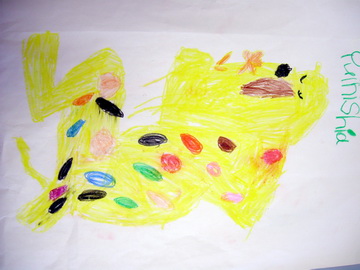
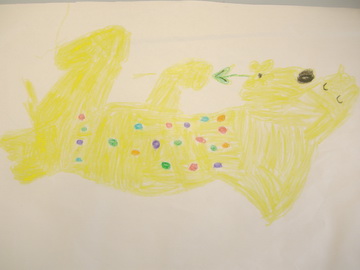
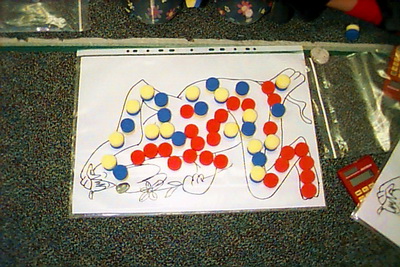
The teacher drew a likeness of the creature, minus the spots, and enlarged it to A3 size to be used by two children with a Poly Plug set and a calculator.
|
|
Content
- 1:1 correspondence
- addition facts beyond 10
- addition facts to 10
- conservation of number
- counting
- data: collecting, recording, displaying
- estimating number
- exploring large numbers
- group (or skip) counting
- mathematical conversation
- mathematics & literacy partnership
- multiplication - array model
- numeral recognition
- pattern recognition
- recording - calculator
- recording - written
- subitising
- subtraction
- tallying
- visual and kinaesthetic representation of number
- writing numerals
|
Original activities from Clayton are included below, but others have been added since by colleagues. The invitation to keep adding to the list is open to all. Email your ideas and/or examples of work from your class to:
Doug Williams, Project Manager, doug@blackdouglas.com.au
Consider these challenges in the light of the example above:
- Name your creature.
- Put plugs on your creature to give it spots.
- Guess the number of spots altogether on your creature? How can you check your guess?
- How many red ones?
- How many blue ones?
- How many yellow ones?
- Write the number of spots on your calculator.
- Move all your spots off your creature and arrange them so they are easier to count.
Do you still get the same numbers?
- Make a graph of the spots on all the creatures in the room.
- Use your spots to make a border (cage) for the creature. Make your border have a pattern.
- Which group can get the most plugs onto their creature? They cannot touch any lines or be on top of each other.
- Pretend the spots are measles and that the creature loses 6 spots every day. Guess, and then work out, the number of days before all the spots are gone and the creature is well again.
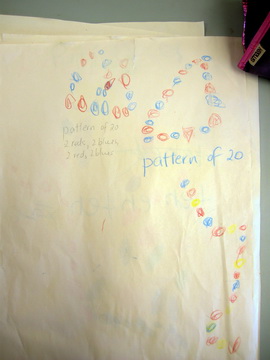
- Today your creature can only use 20 spots, but they can be any of the colours. Find 5 ways to spot your creature. Make a table of red, yellow and blue to record each picture you made.
- In the book the creature can do all sorts of clever things with its spots. Show me all the clever things you can do with the spots on your creature. Make a book.
- ...and so on.
Flinders View Primary School, Reception/Year 1
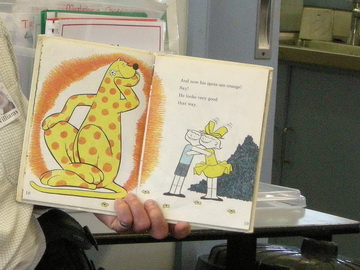
First read the book (again?)... |
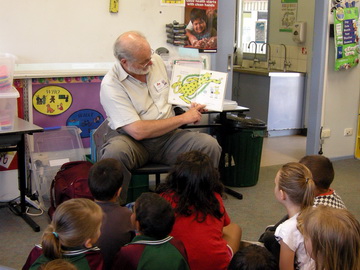
...and enjoy every minute of it. |
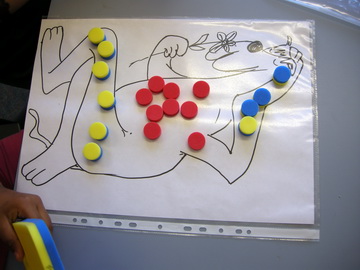
Today Spotty has only 20 spots.
They can be red or yellow or blue. |
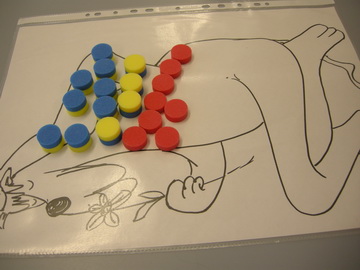
How do you know there are 20?
Can you check it another way? |
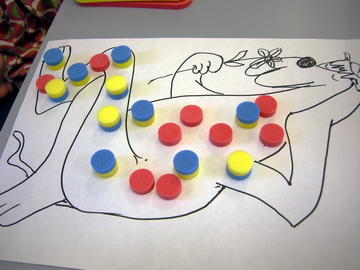
Can you arrange your spots so they are easier to count? |
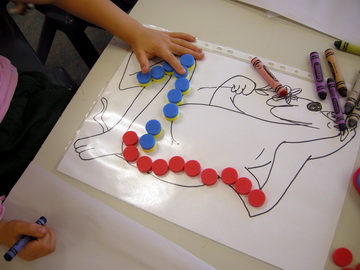
How will you record what you have done? |
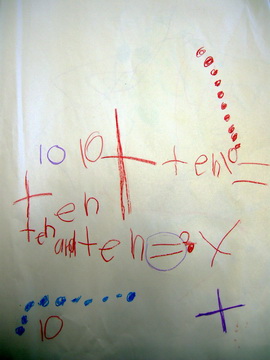
And after 60 minutes or more of playing and counting and checking and talking and questioning and ... well just plain excitement ... these were some of the outcomes. This work was done in the beginning of November (in Australia the school year ends about one week before Christmas).
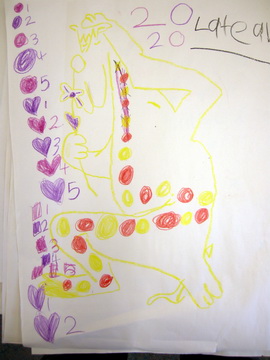 |
Consider the display possibilities.
- Children write, or have scribed for them, a 'speech bubble' explaining their work.
- Today we will count with Mary's Spotty. Arrange your spots the way Mary has...
- Or, as here, photograph children's work and use it with your electronic white board. Mary's work can be shown today as a discussion starter.
- ...
|
Return to Calculating Changes
Activities
Calculating Changes ... is a division of ... Mathematics Centre
|