|
Programming
|
|


|
(Original Document)
|
|
Programming
|
|
|
(Original Document)
|
IF NOT %M0 THEN SET %S21;
END_IF;
IF %M3 THEN SET(%S21);RESET(Channel_0.Pcam_start_stop); Channel_0.ENAB_GROUP0_BITS:=0;RESET(%M3);RESET(%M0);
END_IF;
IF %S1 THEN SET(%S21);RESET(Channel_0.Pcam_start_stop); Channel_0.ENAB_GROUP0_BITS:=0;RESET(Channel_0.OUTS_ENABLE);
END_IF;
IF %M11 THEN TRF_RECIPE (Channel_0, 1,100);RESET(%M11)
END_IF;
IF %M12 THEN TRF_RECIPE (Channel_0,1,850);RESET(%M12);
END_IF;
IF %M13 THEN TRF_RECIPE (Channel_0,0,100);RESET(%M13);RESET(Channel_0.Pcam_start_stop);
END_IF;
IF %M14 THEN TRF_RECIPE (Channel_0,0,850);RESET(%M14);RESET(Channel_0.Pcam_start_stop);
END_IF;
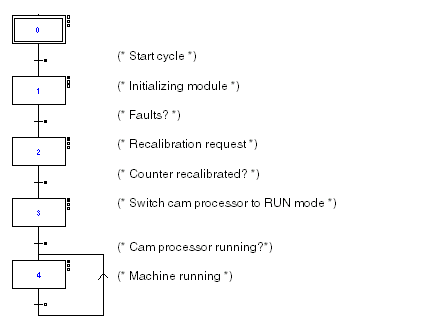
%M0
Channel_0.Group0_and_bits:=16#007F;
(* Reset parts counter *)
SET(Channel_0.Came_pieces_reset);
SET(Channel_0.OUTS_ENABLE);
SET(Channel_0.Evt_ang_enable);
SET(Channel_0.Came_ack_flt);
NOT Channel_0.Ch_error;
SET(Channel_0.Preset_ang_enable);
RESET(Channel_0.Preset_ang_enable);
Channel_0.Ang_ok;
SET(Channel_0.Pcam_start_stop);
Channel_0.Pcam_on;
RESET(Channel_0.Came_pieces_reset);
SET(Channel_0.Pieces_enable);
IF Channel_0.Ch_error THEN SET(%S21); END_IF;
IF %M1 THEN SET(Channel_0.Came_ack_flt);RESET(%M1);
ELSE RESET(Channel_0.Came_ack_flt); END_IF;
IF %M2 THEN READ_STS(Channel_0);RESET(%M2); END_IF;
IF Channel_0.Evt_ang AND %M0 THEN INC(%MW0);END_IF;
IF(%MW0=1)AND %M0 THEN SET(Channel_0.ENAB_GROUP0_BITS.1);END_IF;
IF(%MW0=2)AND %M0 THEN SET(Channel_0.ENAB_GROUP0_BITS.2);END_IF;
IF(%MW0=3)AND %M0 THEN SET(Channel_0.ENAB_GROUP0_BITS.3);END_IF;
IF(%MW0=4)AND %M0 THEN SET(Channel_0.ENAB_GROUP0_BITS.4);END_IF;
IF(%MW0=5)AND %M0 THEN SET(Channel_0.ENAB_GROUP0_BITS.5);END_IF;
IF(%MW0>6)AND %M0 THEN %MW0:=6;END_IF;
IF Channel_0.Evt_ang AND NOT %M0 THEN DEC(%MW0);END_IF;
IF(%MW0=5)AND NOT %M0 THEN RESET(Channel_0.ENAB_GROUP0_BITS.0);END_IF;
IF(%MW0=4)AND NOT %M0 THEN RESET(Channel_0.ENAB_GROUP0_BITS.1);END_IF;
IF(%MW0=3)AND NOT %M0 THEN RESET(Channel_0.ENAB_GROUP0_BITS.2);END_IF;
IF(%MW0=2)AND NOT %M0 THEN RESET(Channel_0.ENAB_GROUP0_BITS.3);END_IF;
IF(%MW0=1)AND NOT %M0 THEN RESET(Channel_0.ENAB_GROUP0_BITS.4);END_IF;
IF(%MW0=0)AND NOT %M0 THEN RESET(Channel_0.ENAB_GROUP0_BITS.5);END_IF;
IF(%MW0<1)AND NOT %M0 THEN %MW0:=0;END_IF;
IF Channel_0.Direction_evt THEN SET(%M15);END_IF;
|
Address
|
Symbol
|
Comments
|
|---|---|---|
|
%M0
|
Dcy
|
Start cycle
|
|
%M1
|
Ack_def
|
Acknowledging fault
|
|
%M2
|
Read_def
|
Reading fault
|
|
%M3
|
Stop_imm
|
Immediate stop of the machine
|
|
%M5
|
Counter_plein
|
|
|
%M11
|
Save_recipe1
|
Saving Recipe 1
|
|
%M12
|
Save_recipe2
|
Saving Recipe 2
|
|
%M13
|
Restore_recipe1
|
Restoring Recipe 1
|
|
%M14
|
Restore_recipe2
|
Restoring Recipe 2
|
|
%M15
|
|
(* Detecting overflow *)
|
|
%MW0
|
Comp_modulo_ang
|
Evt. rollover counter
|
|
%MW2
|
Comp_comp_pieces
|
|
|
%I0.3.0.Err
|
Channel_0.Ch_error
|
Channel error bit
|
|
%I0.3.0
|
Channel_0.Ang_ok
|
Valid angle reading
|
|
%I0.3.0.3
|
Channel_0.Pcam_on
|
Cam processor RUN/STOP
|
|
%IW0.3.0
|
Channel_0.Group0_strack
|
State of tracks i.0 to i.7
|
|
%IW0.3.0.12.0
|
Channel_0.Evt_ang
|
Angle value rollover event
|
|
%IW0.3.0.12.6
|
Channel_0.Evt_pieces_full
|
Reaching limit value for the parts counter event
|
|
%IW0.3.0.12.15
|
Channel_0.Direction_evt
|
Direction of movement on ANG_EVT or TURN_EVT
|
|
%Q0.3.00.0
|
Channel_0.Preset_ang_enable
|
Enables (re)calibration function on angle value only
|
|
%Q0.3.00.5
|
Channel_0.Pcam_start_stop
|
Set: Cam processor start/ cam processor reset stop
|
|
%Q0.3.00.7
|
Channel_0.Pieces_enable
|
Enables the parts counter function
|
|
%Q0.3.00.8
|
Channel_0.Evt_ang_enable
|
Enables the ANG_EVT event source
|
|
%Q0.3.00.14
|
Channel_0.Evt_piece_full_enable
|
Enables the PIECES_FULL_EVT event source
|
|
%Q0.3.00.15
|
Channel_0.Came_ack_flt
|
Command to acknowledge faults present
|
|
%Q0.3.00.23
|
Channel_0.Came_pieces_reset
|
Reset parts counter
|
|
%Q0.3.0.25
|
Channel_0.OUTS_ENABLE
|
Global enabling of track outputs
|
|
%QW0.3.0
|
Channel_0.ENAB_GROUP0_BITS
|
8 enable bits associated with the group
|
|
%QW0.3.0.1
|
Channel_0.Group0_and_bits
|
8 bits for assigning tracks to group outputs
|
