|
General time-division performance characteristics
|
|


|
(Original Document)
|
|
General time-division performance characteristics
|
|
|
(Original Document)
|
|
Function
|
Comments
|
Value
|
|---|---|---|
|
Counter
|
Permitted frequency
|
500Khz in x1
250Khz in x4
|
|
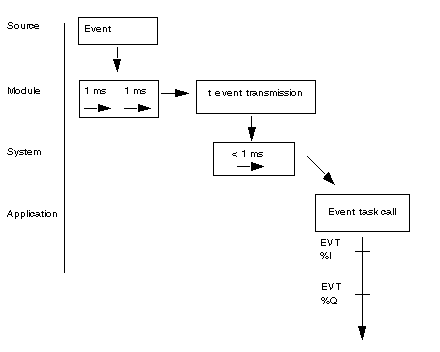
Activation of the event task on switching of cycle
|
< 3 ms
|
|
|
Recalibration of counter on Z marker pulse
|
< 1 micro second
|
|
|
Recalibration of counter on Irec
|
< 50 micro seconds
|
|
|
Event task activation
|
< 3 ms
|
|
|
Cam function
|
Refreshing output
|
50 micro seconds up to 16 cams
100 micro seconds up to 32 cams
200 micro seconds up to 128 cams
|
|
Updating the correction values (anticipation)
|
< 4ms
|
|
|
Activating the event task (cam, parts counter)
|
< 3 ms
|
|
|
Implicit interface
|
Influence of the module on the processor cycle time
|
|
|
Refreshing %I and %IW
|
< 1 ms
|
|
|
Recognizing %Q and %QW
|
< 1 ms
|
|
|
Explicit interface
|
WRITE_PARAM
|
300 ms
|
|
SAVE_PARAM
|
300 ms
|
|
|
RESTORE
|
300 ms
|
|
|
READ_STS
|
immediate (1)
|
|
|
MOD_PARAM
|
send: 20 ms (2)
|
|
|
MOD_CAM
|
send: 20 ms (2)
|
|
|
MOD_TRACK
|
send: 20 ms (2)
|
|
|
TRF_RECIPE
|
300 ms
|
|
|
DETAIL_OBJECT
|
immediate (1)
|
|
|
Additional cycle time
|
The cycle time has no effect on the output reaction time
|
1 ms
|
