|
Defined Architecture: Junctions
|
|


|
Original instructions
|
|
Defined Architecture: Junctions
|
|
|
Original instructions
|
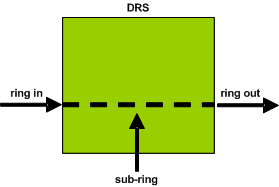
|
Time
|
Ring In
|
Sub-ring
|
Ring Out
|
Comment
|
|---|---|---|---|---|
|
T0
|
1 (started)
|
a
|
–
|
Packet “a” arrived after transmission of packet “1” begins.
|
|
T1
|
2
|
b
|
1
|
Packets “2” and “b” arrive simultaneously.
|
|
T2
|
3
|
c
|
a
|
Packets “3” and “c” arrive simultaneously.
|
|
T3
|
4
|
d
|
2
|
Packets “4” and “d” arrive simultaneously.
|
|
T4
|
5
|
e
|
b
|
Packets “5” and “e” arrive simultaneously.
|
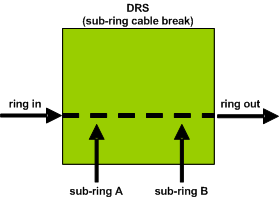
|
Time
|
Ring In
|
Sub-ring A
|
Sub-ring B
|
Ring Out
|
Comment
|
|---|---|---|---|---|---|
|
T0
|
1 (started)
|
a
|
p
|
–
|
Packets “a” and “p” arrive after transmission of packet “1” begins.
|
|
T1
|
2
|
b
|
q
|
1
|
Packets “2” , “b,” and “q” arrive simultaneously.
|
|
T2
|
3
|
c
|
r
|
a
|
Packets “3”, “c,” and “r” arrive simultaneously.
|
|
T3
|
4
|
d
|
s
|
p
|
Packets “4”, “d,” and “s” arrive simultaneously.
|
|
T4
|
5
|
e
|
t
|
2
|
Packets “5”, “e,” and “t” arrive simultaneously.
|
